JOURNAL - ENTRY NO.4

HEIRLOOMS
Most things I grew up with were destined to move on. That's the nature of a dealing family. Objects pass through, are admired, and leave. Permanence was never really part of it, which is perhaps why I find myself so drawn to the small Tunbridge Ware pavilion that sits on our breakfast room dresser.
It belonged to my grandmother. Before that, I'm not entirely sure. My grandfather, father or uncle likely spotted it somewhere on one of their buying trips and thought it 'chancy'. A sewing compendium, or possibly a nutmeg grater, modelled on Royal Pavilion, its painted sycamore onion dome is worn soft by time and handling. These pieces were made in the Pantiles at Royal Tunbridge Wells - spa-town trinkets sold to wealthy visitors, unique to this corner of the South East. Rare then. Rarer now.
I pick it up often. It's beautifully tactile - the kind of object that rewards the hand as well as the eye. In a family where very little stayed put for long, it stayed.
Everyone has something like this, an object that has stayed with them, quietly carrying the marks of time and memory. I spoke with a small circle of friends and people I admire, asking them to share an heirloom of their own: something that has travelled with them, and the memories it holds.
Words: Will Green
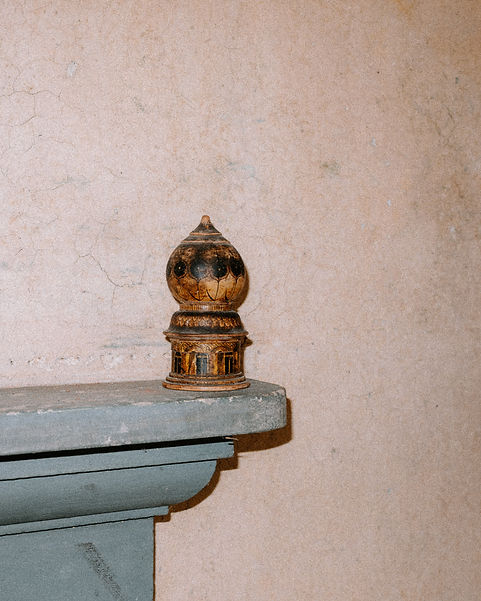

ROBIN LUCAS' FOSSILISED CALYX
I found this tiny item while planting bulbs in the garden. The first human to have set eyes upon it. It is the fossilised ‘calyx’ of a sea lily (probably of the genus Platycrinites). These creatures flourished about 340 million years ago, in warm shallow seas. They formed softly billowing ‘meadows’, bathed in warm sun and calm waters, so far removed from the wild landscape of North Lancashire today. Despite looking plant like, they are in fact related to starfish, sea urchins and sea cucumbers. Their distant cousins can still be seen in tropical seas to this day.
When I pick up this tiny piece of history, I feel infinitesimally small. It is beautiful and precious to me despite having little monetary value.
The word ‘heirloom’ for me is about the feeling of being transported to a different time and place, and the awareness that we are only a heartbeat in time. This object really sums that up for me, it comes from a time so far before humans had evolved that it’s hard to comprehend, and it will continue to exist well after we have become extinct.
Words: Robin Lucas, Artist, Gardener & Designer
ARNE MAYNARDS' YEW SCULPTURE
I am the youngest of four boys, brought up by my late mother, a beautiful, gentle soul who lived to see her 94th birthday. Before she died my mother gave me a tiny sculpture - five angelic figures carved into an exquisite piece of yew - a piece I have known and loved for as long as I can remember. It is a warm, tactile piece, inviting regular touch, and has been smoothed and polished over many years.
My father died when I was just a few months old, and I have no recollection of him. My world was shaped and governed by my mother, my grandmother and my godmother, all fearless women who shared a deep-rooted love and respect for the natural world. I believe my mother bought it not long after my father died, from the Hambledon Art Gallery in Blandford Forum in Dorset, close to where I grew up. It lived on my mother’s desk, a quietly contained gathering of angels that I imagine helped her through difficult moments, especially when we were all so young. My grandmother lived in Germany and would occasionally visit. I remember she would admire it and evidently my mother gave it to her one birthday, or Christmas perhaps, as I remember it leaving to live in Germany on my grandmother’s desk. It now, of course, lives on mine.
It is unsigned and so I don’t know who the artist was, but I’ve often wondered if it has links to Elizabeth Frink, an early maquette for a larger piece perhaps? It is a gentle, spiritual object that over time has absorbed many thoughts, worries and sorrows. It is a source of great joy to me now; an instant reminder of the women who helped shape me. It has always been a part of my life and I love it dearly.
Words: Arne Maynard, Garden Designer
Photograph: ©William Collinson

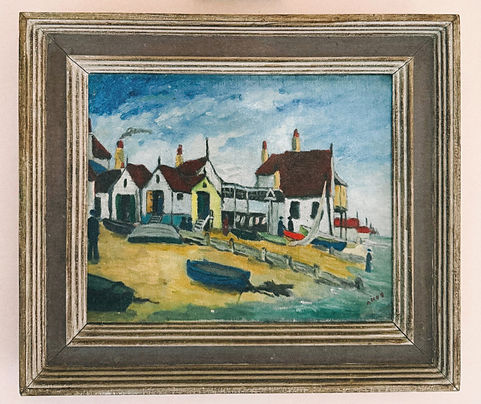
PADDY O'DONNELL'S PAINTING
My object or ‘heirloom’ is a picture I bought at my very first auction back in the late 1980’s. It’s of no great value but was purchased for a song, £5 if memory serves me well. It’s a painting, possibly of Whitstable in Kent, but open to debate by an artist called Ernest Hamilton Amor. A naïve seaside vignette in vivid colours of azure, acid yellow and Kelly green, to name a few, it has such charm and is painted with such naïve freedom. The artist was a contemporary of Rex Whistler, but definitely not at the same level of talent and ambition!
The painting has travelled with me from my bedroom at my parents’ house to my very first house in the early 90’s, to London, then Ireland and now back in Blighty. I recently had it re-framed by the brilliant Gale & Co in Birmingham, and it’s made an extraordinary difference from the frame I bought it in – it’s come alive and feels more settled, less lurid. I walk past it every day, and smile – it reminds me of my 1st terrifying day at auction bidding, it felt madly grown up and serious – I had been on the other side at auction houses doing part-time at Phillips Auction Rooms in Knowle, latterly Bonhams, but never in a position to bid or thought that was a terrain open to me.
Hopefully, the painting will carry on its journey as a life companion unless someone tells me he is madly fashionable, and I can make a killing!!!
Words: Paddy O'Donnell, Farrow & Ball Brand Ambassador & Freelance Designer
WILFRED LEWIS' DRINKING GLASS
This is a glass I stumbled upon and bought, which has my initials/name engraved on it, along with a date of 1874. What makes it a little more interesting is that it’s a mid-18th-century glass, and so the name was added only halfway through its life. I recently moved to the US and travelled on one of my many runs with a carry-on case carefully stashed with my collection of antique glasses – I’m pleased to say they made it over without a single casualty.
So what we have is a 200+ year old English glass, which someone with the same initials as I decided to engrave in 1874 and which remains in regular use here in NYC. There’s something particularly evocative about objects of everyday purpose which can still be used and enjoyed as only the latest in a long line of long-dead individuals.
Words: Wilfred Lewis, Interior Designer for Remy Renzullo Design & Interiors Editor at Scenery magazine


ROLLO DUNFORD WOOD'S PAINTING
Perhaps my most cherished heirloom has only come into my possession in the last month, after the passing of my dear father, the painter and all-round creative powerhouse Hugh Dunford Wood.
It is a painting of a mature lady dressed in red, sitting at a table before a roaring fire. An open bottle of whiskey, a mug, and an old oil lamp rest on the table, and she looks as though she could be in full swing of a folk song.
The lady was Peggy Angus, the celebrated designer and printmaker, and mentor to my father, fresh out of art school. She sat for him in the dining room of her house, Furlongs, on the South Downs in the early ’80s, a cottage we visited regularly.
The painting connects me to my father, who gave it pride of place in every studio he had, and to her ethos of living a rich, fulfilled creative life, which inspired my parents as they raised us in the wilds of Warwickshire with thoughtfulness, wonder, and creativity.
Both Peggy and my father have now gone, but this painting remains a quiet creative compass in my life and a beautiful reminder to seize the day.
Words: Rollo Dunford Wood, Craftsman & Designer
MARTA DE LA RICA'S NECKLACES
The heirloom I would like to share is not a single object, but rather something that is still in the making.
Since my daughters were born, I have been creating for each of them a necklace to which I add charms over time. Some mark personal milestones, others are small, almost accidental finds - objects that somehow capture a moment, a place, or a feeling. Among them, there are also pieces that come from my own family. One in particular - a small heart set with stones, holding a photograph of a much-loved uncle on its reverse - once belonged to my grandmother.
To me, an heirloom is not only something that is passed down, but something that is built over time - a living object that gathers memory, emotion and presence. It is less about preservation and more about continuity.
Words: Marta de la Rica, Interior Designer


CAMILLA FRANCES' OBJECTS
When I was about 15, my godmother, Rosie, died after a long illness. She was a wonderful person, very erudite and fascinated by art, antiques, and textiles. In her will, she left me a very special and quite unusual gift: a sum of money that, by the terms of her will, could only be spent at an auction house.
Going to auctions and hunting for antiques at flea markets was a real interest of hers and I think she was hoping to pass this love on to me by gifting me that experience; while also ensuring I spent the money on something that would endure.
I took it seriously and spent every weekend visiting Lots Road in Chelsea, and Bonhams, among other auction houses, trying to find something I loved. I’m indecisive by nature so it wasn’t easy, but eventually I settled on an English walnut wing chair, upholstered in Belgian linen, and a late 18th-century to early 19th-century teak campaign chest with original brass handles.
I was young and my taste (and collecting) has evolved since, but I still live with, use, and love them both; they are classic, timeless pieces with beautiful proportions. I have other objects that are more special or aesthetically exciting, but these two have travelled with me, particularly because of how and why they came to me. It was an inspired gift to leave a young person and had a big impact; I’m sure it’s one of the reasons, if not the reason, why I’ve always loved antiques.
Words: Camilla Frances, Digital Editorial Director at Cabana